Vampiris Bacterium
I Am LegendVampiris bacillus is the bacterium Robert Neville identifies as the material cause of vampirism. Seen through his microscope rather than through vampire folklore, it turns an apparently supernatural catastrophe into a disease process with a discoverable agent, a life cycle, environmental conditions, and routes of transmission. The discovery gives Robert Neville an explanation for the plague, but it arrives too late to restore the ruined society and cannot by itself resolve the psychological and social meanings attached to the infected.
Discovery and Naming
Robert Neville reaches the bacterium only after abandoning the assumption that vampires alone could have spread the plague so quickly. His reading reminds him that flies and mosquitoes can disseminate bacterial disease mechanically, and he connects that possibility with the plague's geometrically mounting number of victims. Nightly vampire attacks could not adequately account for such extraordinary speed; insects, moving between hosts, offered a mechanism capable of carrying infection through the wider population. The apparently minor presence of a mosquito therefore becomes part of a much larger epidemiological pattern.
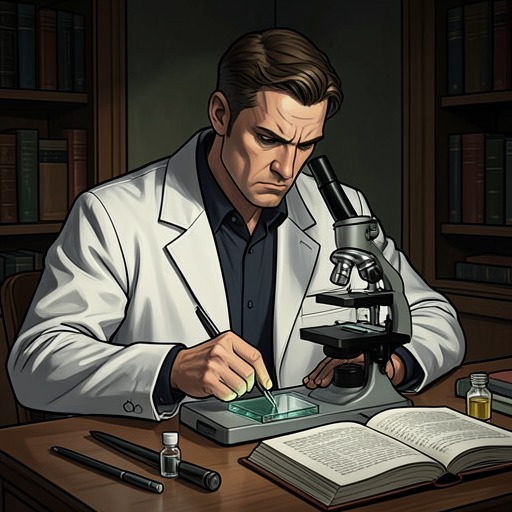
The laboratory work is painstaking. Robert Neville spends days trying to mount a few drops of blood correctly, center the cell on the slide, and bring the specimen into focus. On his thirty-seventh slide, he finally sees a germ fluttering delicately beneath the microscope. Because a virus would not be visible in that way, he recognizes that the agent is bacterial and names it vampiris. The naming is an act of scientific classification, but it also marks a historical reversal: centuries of fearful superstition are reduced, at least in material terms, to a microscopic organism.
Robert Neville then consults bacteriology texts and identifies the organism as a bacillus, a cylindrical rod of protoplasm that moves through blood by means of hairlike flagella projecting from its cell envelope. These flagella lash against the surrounding fluid and propel the bacterium forward. The detail matters because Vampiris bacillus is not merely an abstract symbol of contagion. It is presented as an active biological agent whose structure and movement explain how infection can inhabit and transform a body.
Biological Operation
Robert Neville's model begins with blood. The bacillus creates an isotonic solution in the blood, slows its circulation, activates bodily functions, lives on fresh blood, and supplies the energy that enables the infected host to seek more of it. In this account, the vampire's hunger is not simply a moral appetite or a supernatural curse. It is the behavioral expression of a symbiotic biological arrangement in which the organism feeds the host's activity while the host supplies the organism's necessary nourishment.
The organism also accounts for physical transformation. Robert Neville associates it with the growth of the canine teeth, making a recognizable feature of the vampire part of the infection's bodily effects. The same process that produces heightened activity and blood dependence therefore reshapes the host's visible anatomy. Folkloric signs become symptoms, and the body becomes evidence that can be studied rather than merely feared.
Vampiris bacillus is described as a facultative saprophyte, capable of living with or without oxygen but behaving differently under those conditions. Inside the infected system it is anaerobic and establishes a symbiosis with the host: the vampire supplies fresh blood, while the bacterium provides energy for further feeding. When air enters, however, the organism becomes aerobic and virulently parasitic. The relationship changes instantaneously from cooperation to destruction, and the bacterium begins to consume the host.
Blood deprivation produces another stage in the organism's life cycle. When no blood is available, the bacilli metabolize abnormally, absorb water, swell, and ultimately threaten to explode and destroy the cells around them. Robert Neville hypothesizes that unfavorable conditions trigger sporulation. The cell contents condense into an oval body enclosed by a thick wall; the resulting spore detaches from the bacillus and becomes highly resistant to physical and chemical change. When conditions improve, it germinates and recreates the qualities of the original organism.
This hypothesis explains the vampire's coma. If the host receives no blood, Vampiris bacillus protects itself by sporulating, and the vampire sinks into an apparently deathlike state. When favorable conditions return, the germ becomes active again and the host walks once more, physically unchanged. The apparent boundary between death and life is thus recast as a phase in the bacterium's survival strategy.
Transmission and Plague Ecology
Robert Neville extends the sporulation theory beyond the individual body. If a vampire does not enter a coma, its body can decompose without blood, releasing spores into the environment. Dust storms carry those spores, and scaling dust creates minute abrasions in human skin where they can lodge. Once inside the skin, a spore germinates and multiplies by fission. The surrounding tissues are destroyed, channels become plugged with bacilli, and the decomposition of tissue cells and bacteria releases poisonous bodies into neighboring healthy tissue. When those poisons reach the bloodstream, the infection is complete.
This chain links weather, damaged skin, decomposition, and circulation. It also explains why Vampiris bacillus can spread beyond direct contact with an established vampire. The plague is not confined to nocturnal attacks; its reproductive forms move through air, dust, insects, and vulnerable bodies. The reference to flies and mosquitoes supplies a second environmental pathway, while the dust-storm hypothesis supplies a mechanism for infection after infected bodies decay. Together they make the catastrophe's speed intelligible as an ecological event rather than a sequence of isolated supernatural assaults.
The public response reflects the perceived danger of the organism. Because only flames are believed capable of destroying the bacteria that cause the plague, the law requires every body to be transported immediately to the fires after death. Funeral parlors are closed, and morticians who remain healthy enough to work are prevented from practicing. Robert Neville understands the logic of the policy but refuses to surrender Virginia Neville to it, preserving his vow that she will not be burned. The bacterium therefore reaches beyond medicine into law, mourning, marriage, and the treatment of the dead.
Limits of the Bacterial Explanation
Robert Neville initially tries to attribute every vampire phenomenon to Vampiris bacillus. His later work forces him to separate physical effects from psychological ones. Having read about hysterical blindness, he recognizes that some phenomena may be physically caused while others are psychological, and that not every apparent violation of natural law belongs to the bacterium. This revised approach does not undo the discovery; it makes the discovery more precise by restricting what it can explain.
The distinction is especially important because vampirism is repeatedly interpreted through religious language. In the revival tent, a speaker describes the plague as divine punishment, a second deluge, and the return of the dead from their crypts. The crowd's terror converts infection into a moral and theological drama. Vampiris bacillus offers a rival vocabulary: transmission instead of wrath, spores instead of resurrection, symptoms instead of damnation. Yet the religious explanation remains socially powerful because it organizes fear and collective identity in ways laboratory facts cannot.
The same tension appears in Robert Neville's encounters with infected people. When Ruth retches at the sight or smell of blood, he identifies her as one of the infected, but the label carries more than a clinical observation. It turns a bodily response into evidence of danger and betrayal. Later, Ruth explains the new society's violence in similarly biological and political terms: the infected cannot allow the dead to exist beside the living, and those with impaired brains are understood to exist for one purpose and therefore to require destruction. The bacterium helps establish the material basis of the new order, but social groups decide what infection means and whom it authorizes them to kill.
Significance
Vampiris bacillus transforms Robert Neville's investigation from a defense against folklore into a history of disease, adaptation, and social replacement. Its visible form under the microscope destroys the assumption that vampires are inexplicable monsters, while its flagella, blood dependence, sporulation, and environmental transmission provide a coherent account of the plague's persistence. The organism explains why the old world fell and why the infected can continue beyond the apparent death of their hosts.
At the same time, the concept exposes the danger of treating scientific explanation as complete explanation. The bacillus can describe how bodies change, how spores survive, and how infection spreads; it cannot by itself determine who counts as human, which deaths are lawful, or whether the survivors' violence is self-defense or persecution. Robert Neville's discovery gives him the truth of the pathogen, but the new society gives that truth a different political meaning. Vampiris bacillus is therefore both a scientific breakthrough and the foundation of a tragic reversal in which the once-isolated investigator becomes an object of collective fear.